
 by
by 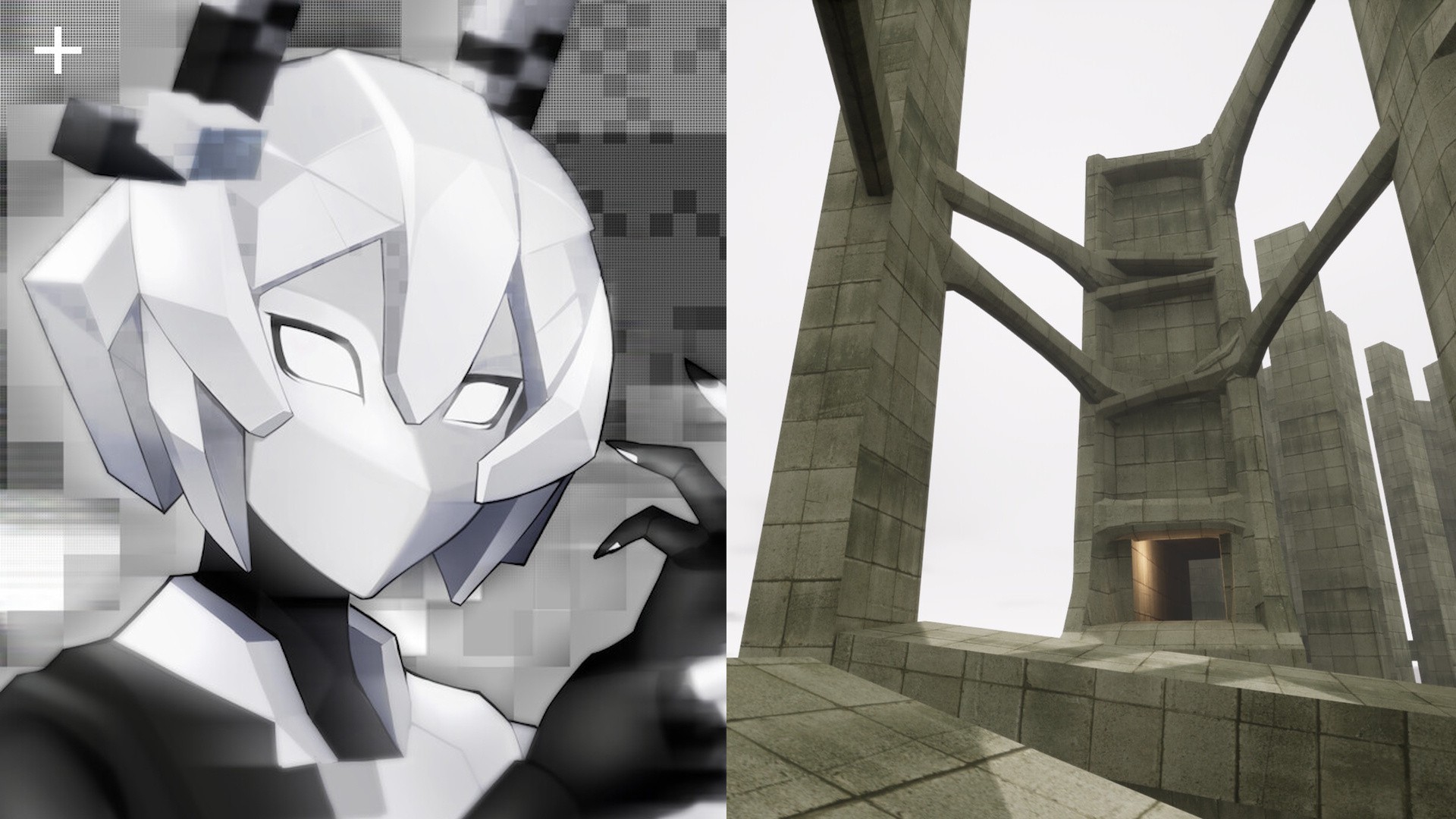
VHOLUME and Cicadamata both released at the same moment, late on Friday afternoon, launching off the starting blocks and synched perfectly in their sprint to commercial and critical acclaim. A pair of highly-anticipated games about racing through surreal, frequently abstract environments, chasing optimized times and occasionally hunting for secrets. And for all their similarities, they couldn't be more different. I picked up both and played through them over the weekend. Credits were rolled, endings were seen.
I have only just begun, and I knew that I'd be losing many more hours to these two games.
Neither of these games is lengthy - maybe two hours apiece, at least on your first trip through. You're just learning the track, getting your first tour, and sketching out your first mental notes. Whether it's Cicadamata's abstract cyberscapes (equally inspired by Bungie's 2026 extraction shooter reboot of Marathon and whimsical PS1 classic Jumping Flash) or Vholume's decaying brutalist megastructures (part Blame!, part trademark of the Lemaitre bros, developers of STRAFTAT & Babbdi), these are massive environments designed to be moved through very quickly.
They're also frequently beautiful, in their own strange ways, and well worth taking it slow from time to time. As much as the UI might scream for urgency, these are environments equally built to be taken slow and soaked in, especially if you want to scour them for secrets - deeper narrative hooks in the case of Cicadamata, and bonus B-side levels in Vholume.
And yet the way you move around these environments couldn't be more different. Yes, these are both games about racing against the clock and climbing your way up public leaderboards, challenging other player's ghost times, but you interact with their environments in very different ways. In Vholume, your hands and feet are ever so tangible, as you breezily dash through its vast, inhuman structures with impossible stamina. Wall-running, scrambling up ledges, and sliding under low obstacles are your only real techniques, encouraging mastery of racing lines, cutting corners, and optimizing movements. It feels weighty yet dreamlike, as you hurl your virtual body through each obstacle course. Think Mirror's Edge meets a dream where you just can't stop running, ever.
Cicadamata, on the other hand, demands twitch shooter precision. While some of your score comes from completing stages quickly, air-dashing and triple-jumping through each obstacle course (each requiring you to pick up four glowing yellow cores then reaching an exit point), much of that final ranking comes from killing enemies, with extra points awarded for combos, multi-kills and goomba-stomping enemies. The enemies are an abstract assortment of red polygon birds, crabs and gun turrets, for the most part, dispatched easily with your menacingly chatty gun, Joyeuse. A tap of the fire button launches a spread of slow-ish projectiles. Holding the right mouse button charges up a heavy sniper shot that also prompts your seemingly sapient weapon to send messages through your HUD, like "YOUR HANDS TREMBLE, AND I LOVE IT." and "I WILL WATCH YOU BREAK."
It's a hell of a juxtaposition against the bright retro aesthetics of the world and the almost-cute enemies. Cicadamata might be a bloodless experience set in surreal locales, but there's a real sense of menace just under the surface. Sticking around in your starting dropship at the start of each world gives you a little extra bit of backstory and worldbuilding. Quite how it squares up with the world you're seeing is left mostly up to interpretation for now, but it's not a happy universe, and neither is your masked gunslinger - FAWN-A2. The few bits of lore you do get are enticing, with hidden terminals (another nod to Marathon) encouraging you to take things slow and soak up the story now and then, in between bursts of arcade violence.
Vholume, on the other hand, paints its menace front and center, but never with any active threat of violence, merely the horrible grinding realization of being trapped in a machine that's slowly bleeding to death. Never quite explaining who you are or why you're racing through it, it feels like a nightmare vision of being late for work in an anxiety-inducing urban sprawl. Racing through streets ill-fitting for humanity, occasionally meeting a strange naked human-ish creature that talks to you about the joys of bureaucracy and directing you to the next office for reasons unknown. But stopping to talk to them is what you do when you're not on the clock.
Both games are also going to grow over time. Vholume has already put further development in the hands of its community. Anyone can pop open the Unreal Engine editor and create a level for it, easily shared on the Steam Workshop, and there are some great environments already. While most are in the brutalist aesthetic of the original game, there are a few more whimsical ones, like a trip to Bob-omb Battlefield from Mario 64, which feels just weird to wall-run around so freely.
Cicadamata, on the other hand, is a bit more mysterious. After completing the current set of 18 levels, you unlock a few extra bonus stages, with the menu suggesting that more might come soon, or never. But more interestingly is the game's starting menu, hinting at a second episode on the way. Whether it's going to be a free update or a paid expansion, I don't know, but given how much fun I've already had with it so far, I'd be happy to pay for more.
Either way, in the meantime, mastering these initial levels in both is going to fill far too many waking moments. These games are perfectly sized to fit into a 5-10 minute break of a few runs, or a multi-hour grind if you get really in the zone. Perfection is attainable, with enough sweat and tears. Each game has some esoteric movement tech to learn. For Vholume, it's bunnyhopping while sliding, seemingly removing friction from your backside and letting you glide at increasingly uncontrollable speeds, your inertia retained only so long as you run on walls, never the floor. Cicadamata's seems to be abusing slopes, which put you into a high-speed slide reminiscent of Counter-Strike, able to launch you vast distances if you jump off at the right angle and time. I've yet to master either of these, but I'm looking forward to putting in the time.
One thing that will make those hours of grinding feel all the easier is each game's soundtrack. Vholume's is perfectly understated, fitting its vast and hollow concrete world. Dreamy ethereal synth-work, courtesy of Signalis musician 1000 Eyes. It's music that you sink into, losing track of time. Standing at direct odds with that is Cicadamata's screamingly intense breakbeats that sound half like something from a long-forgotten PlayStation classic, half like whatever the freshest, rawest Femtanyl cut is, with some intense, distorted screaming vocals just for a little extra oomph. Music to tear flesh from bone, if I ever heard it. Two soundtracks I'm also considering adding to my regular playlist.
Surprisingly, Cicadamata and Vholume aren't in a discount bundle together, though they are also bundled with some other excellent indie games. Cicadamata costs £9.09/$10, and Vholume is £6/$8. Both of them have 10% launch discounts running until August 28th, and both have my highest recommendation. Vholume also has a demo, too. No review scores here - that's the domain of someone who has sunk a dozen hours or more into each of these. And I probably will, given time. Wish me godspeed, and I'll see you on the leaderboards.
Comments 0
Wow, no comments yet... why not be the first?
Leave A Comment
Hold on there, you need to login to post a comment...